
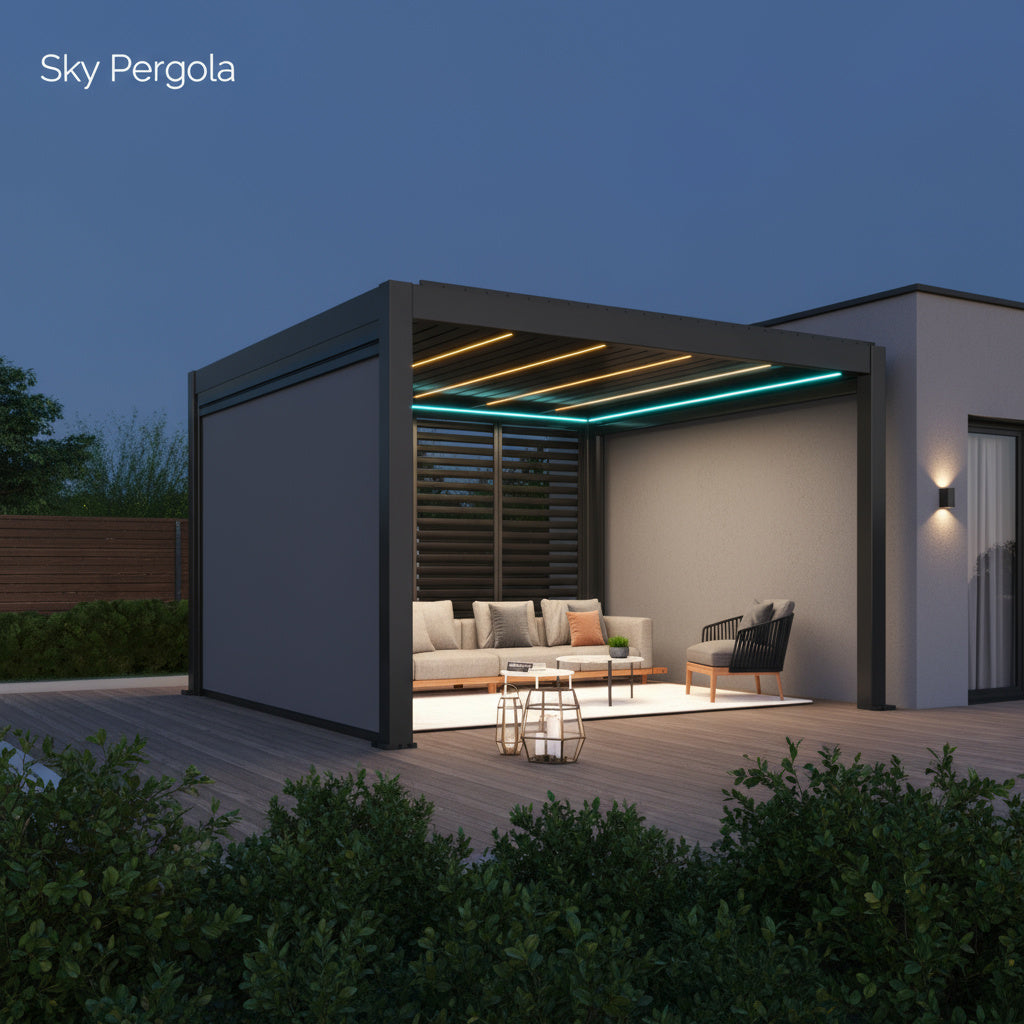
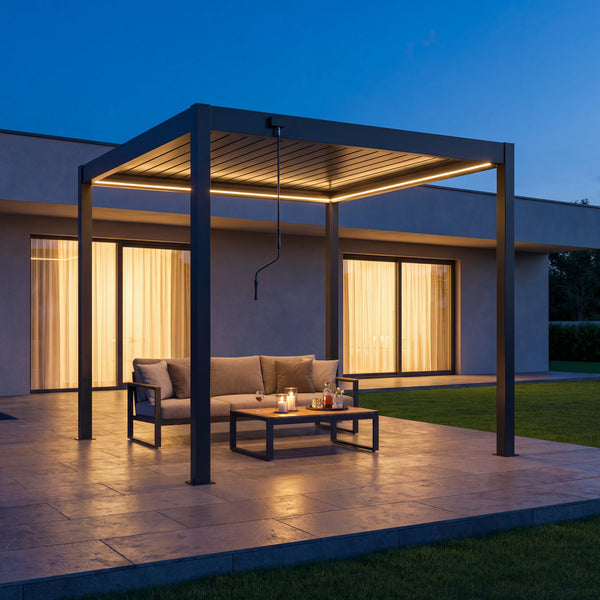
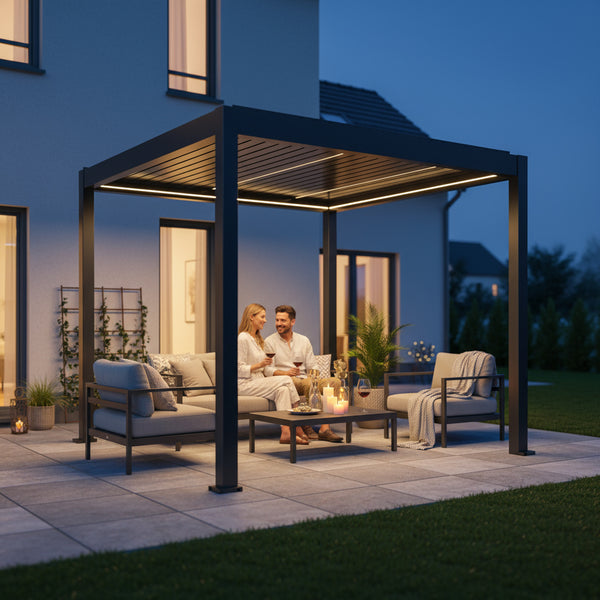
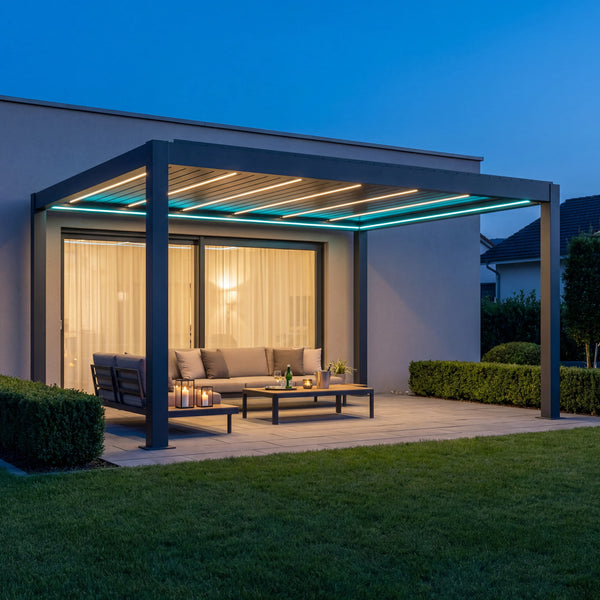
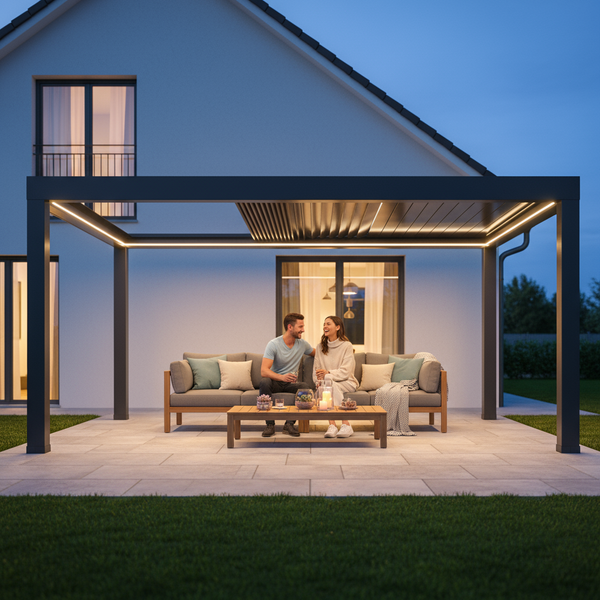
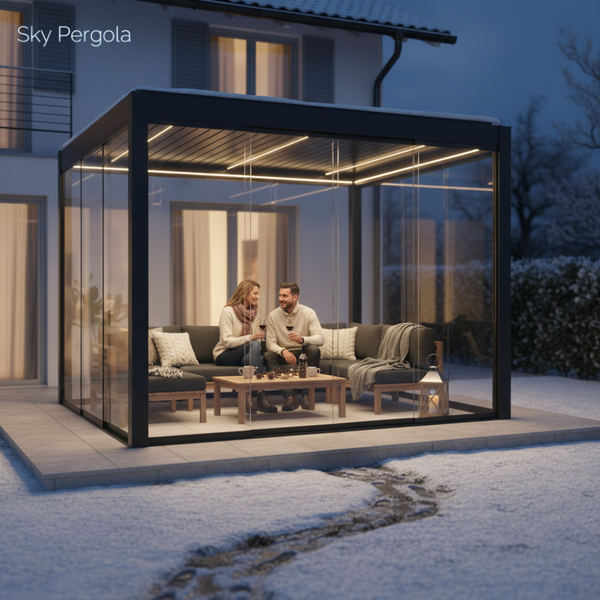

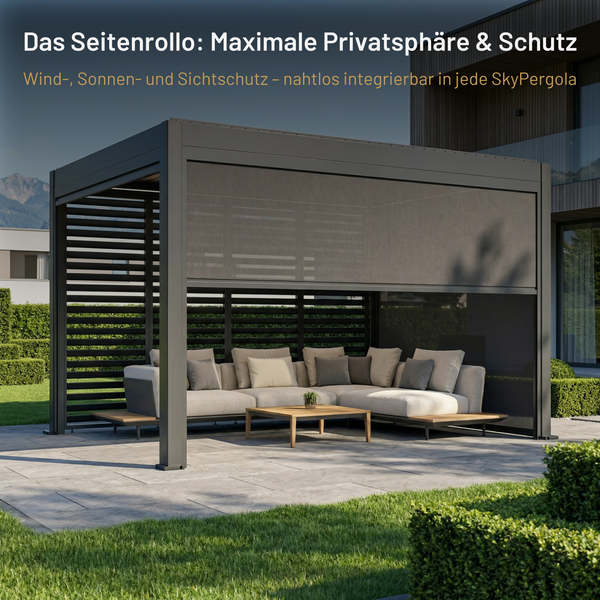
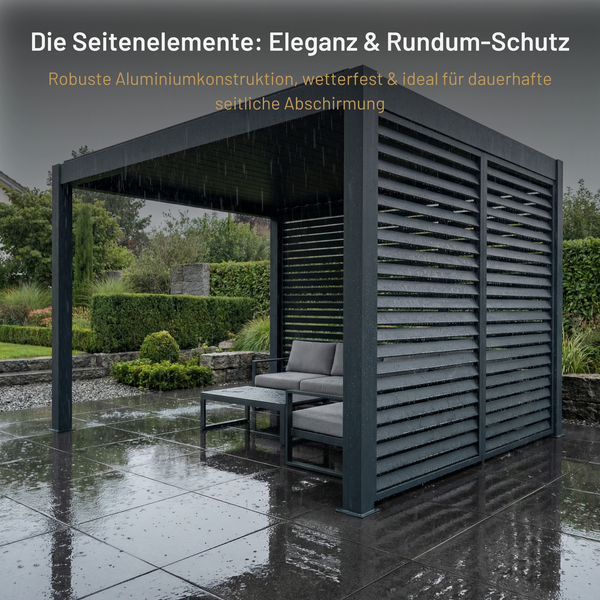



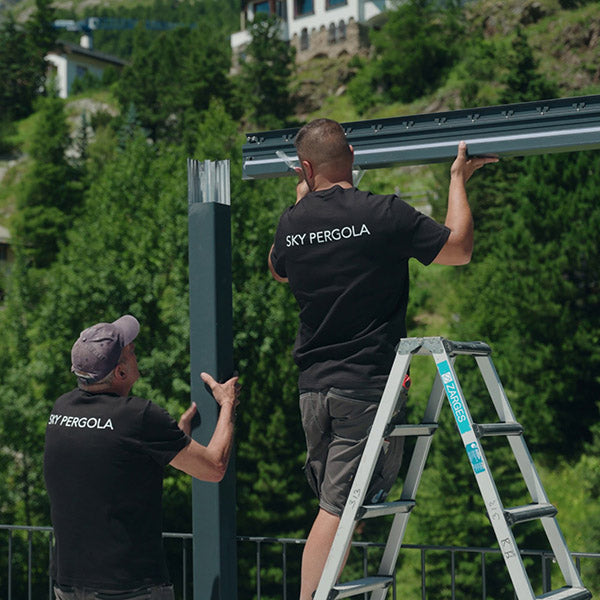

If you want to attach a pergola to the house wall, several factors determine durability and tightness: the wall structure, the correct fastening technique, and especially the professional sealing of the wall connection. A wall-mounted pergola saves space and acts as a natural extension of the house but requires higher execution standards than a freestanding version.
In this guide, you will learn which substrates are suitable, how fastening to the wall connection profile works, and how to keep the transition between pergola and wall permanently watertight. Sky Pergola is a Swiss manufacturer of aluminum pergolas with motorized louvered roofs and delivers to Germany, Austria, and Switzerland.
Wall mounting or freestanding: the right fundamental decision
In principle, a Sky Pergola can be mounted both freestanding and on the house wall. Both options are valid, and the choice depends on the terrace situation, wall condition, and your design preferences.
- Wall mounting: The pergola is connected to the building wall and supported only on the opposite side by posts. This saves space, provides a seamless transition to the interior, and is ideal for classic terraces directly at the house.
- Freestanding: The pergola stands on four (or more) independent posts and is independent of the wall. This is the right choice if the facade is unsuitable (e.g., sensitive thermal insulation composite system) or if the pergola is to be placed in the middle of the garden.
Read more about construction and application options on our pages about terrace roofing and louvered roofs.
Suitable wall types and substrates
Before attaching a pergola to the house wall, it must be clear whether the wall can permanently bear the loads. Load-bearing walls are usually solid walls made of masonry or concrete. Special care is required for insulated facades.
Overview: substrate, suitability, and fastening
| Substrate | Suitability | Recommended fastening |
|---|---|---|
| Reinforced concrete | Very good | Heavy-duty anchor / concrete composite anchor |
| Solid brick / clinker | Good | Dowel with appropriate length, if necessary bonding mortar |
| Perforated brick / hollow chamber block | Conditional | Injection anchor with sieve sleeve |
| Aerated concrete / lightweight concrete | Conditional | Special Anchors for Aerated Concrete, Professional Inspection Required |
| ETICS / Insulated Facade | Special Case | Load Transfer to Load-Bearing Masonry, Professional Consultation Required |
Special Case ETICS and Insulation
A thermal insulation composite system (ETICS) is not load-bearing. If the fastening is anchored only in the insulation layer, it will not support the loads of a pergola. The load must be transferred via suitable spacer mounting systems to the underlying load-bearing masonry without unnecessarily compromising the insulation or creating thermal bridges. Since execution depends on insulation thickness and wall construction, always consult a professional in this case. When in doubt, the freestanding option is the safer and often more cost-effective solution.
Fastening Technology: Wall Connection Profile, Anchors, and Plugs
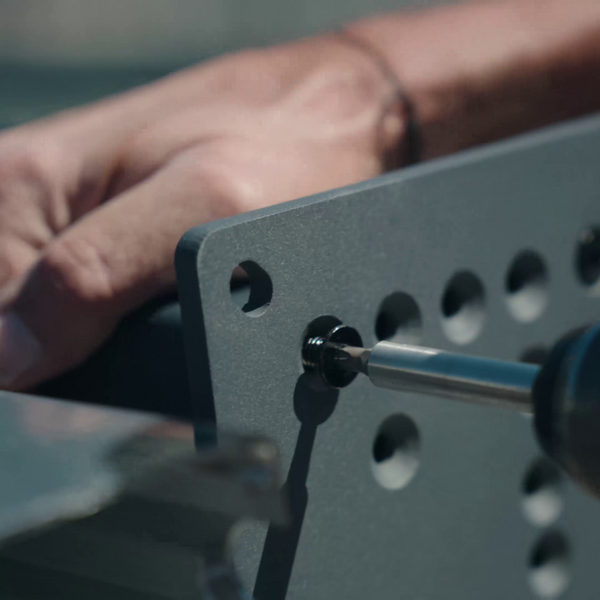
The core of the wall installation is the wall connection profile. It is screwed horizontally to the facade and supports the louvered roof on the wall side. A clean, load-appropriate screwing is the foundation for stability and tightness.
- Align the Profile: The wall connection profile must be set exactly level so that the louvered roof achieves the intended slope and water can drain properly.
- Drilling and Anchoring: Use the appropriate type of anchor or plug and the correct anchoring depth for each substrate. Too short or unsuitable anchors are one of the most common sources of error.
- Observe Spacing: Fastening points should be evenly distributed along the entire profile length to prevent point loads.
- Corrosion Protection: For aluminum pergolas, use suitable, corrosion-resistant fastening materials to avoid contact corrosion.
Exact drilling patterns, torque settings, and load assumptions vary depending on the model and size. To be on the safe side, have the installation carried out by the SkyPergola team – this ensures the fastening matches the respective structural requirements. An overview of our models can be found in the Pergola Collection.
Properly Seal the Wall Connection
Sealing is the most critical point of any wall installation. Exactly where the profile meets the facade, rainwater can penetrate if the connection is not properly executed. The goal is to safely direct water away from the wall instead of allowing it to collect behind the profile.
Basic Principles of Sealing
- Backflow protection: The upper transition between profile and wall is designed so that water cannot run behind the profile. Commonly, this is achieved with a combination of a cover or connection sheet and permanently elastic joint sealant.
- Suitable sealants: Use weather- and UV-resistant, permanently elastic sealants approved for outdoor use and the respective substrate. The joint should be clean, dry, and dust-free.
- Clean facade connection: Cracks or open spots in the plaster around the profile are sealed beforehand to prevent water from penetrating the facade itself.
Slope and water drainage
A well-thought-out water drainage is at least as important as joint sealing. The louvered roof of a Sky Pergola is waterproof when the louvers are closed and directs rainwater via an integrated drainage system down the post in a controlled manner. For this system to work, the roof must be installed with the intended slight slope so that water reliably flows to the drainage points and does not accumulate at the wall.
Common errors in wall mounting
- Wrong anchor in the wrong substrate: Standard anchors in hollow bricks or aerated concrete do not reliably hold the loads.
- Fastening only in the insulation layer: With ETICS without load transfer to the supporting wall, the fastening will eventually tear out.
- Neglected sealing: A roughly sealed wall connection will sooner or later cause moisture damage to the facade.
- Missing or incorrect slope: Without the correct slope, water accumulates and the integrated drainage cannot function.
- Contact corrosion: Unsuitable fastening materials combined with aluminum can cause corrosion.
Many of these errors can be avoided from the start with professional installation. Sky Pergola offers up to 10 years warranty – another reason for expert execution.
Models and prices at a glance
Which pergola suits your wall situation depends on size, features, and budget. Our models provide an initial guide:
- SkyLite ECO – the entry-level model, from approx. €4,440.
- SkyMotion LED – with integrated LED lighting, from approx. €5,410.
- SkyMax Ultra – the premium model, from approx. €9,100. Details can be found on the SkyMax Ultra Pergola page.
Further information on configuration and costs is available at Buy Pergola and on our page about the Pergola Price. Suitable solutions for the terrace are also shown in our collection for Terrace Shading.
Frequently Asked Questions
Can I attach a pergola to any house wall?
No. Suitable are load-bearing walls made of solid masonry or concrete. For hollow-core bricks, aerated concrete, or insulated facades (ETICS), special fastenings or load transfer to the load-bearing wall are necessary. In such cases, you should always seek professional advice or choose the freestanding option.
How is the wall connection sealed against rain?
The upper transition between the wall connection profile and the facade is designed so that no water can run behind the profile, usually with a connection sheet or cover and a permanently elastic, UV-resistant external joint. Additionally, a slight slope is important so that water flows in a controlled manner to the drainage points.
Is a wall-mounted Sky Pergola waterproof?
Yes. With closed slats, the motorized louvered roof is waterproof. Rainwater is drained down through an integrated water drainage system in the post. The prerequisite is correct installation with the intended slope.
Should I rather install the pergola freestanding?
A freestanding pergola makes sense if the facade is not load-bearing, there is a sensitive ETICS (external thermal insulation composite system), or the pergola should not be directly attached to the house. If a load-bearing wall is available and a seamless transition to the house is desired, wall mounting is usually the more elegant solution.
Can Sky Pergola handle the installation?
Yes. Professional installation by the Sky Pergola team is possible and ensures that fastening, sealing, and water drainage are carried out properly. We offer up to 10 years warranty on the pergola. Sky Pergola delivers to Germany, Austria, and Switzerland.
Would you like to have your pergola securely attached to the house wall? Book a non-binding inspection and configure your pergola now or call us at +49 761 87003550 – the Sky Pergola team will advise you on the substrate, fastening, and sealing.


