
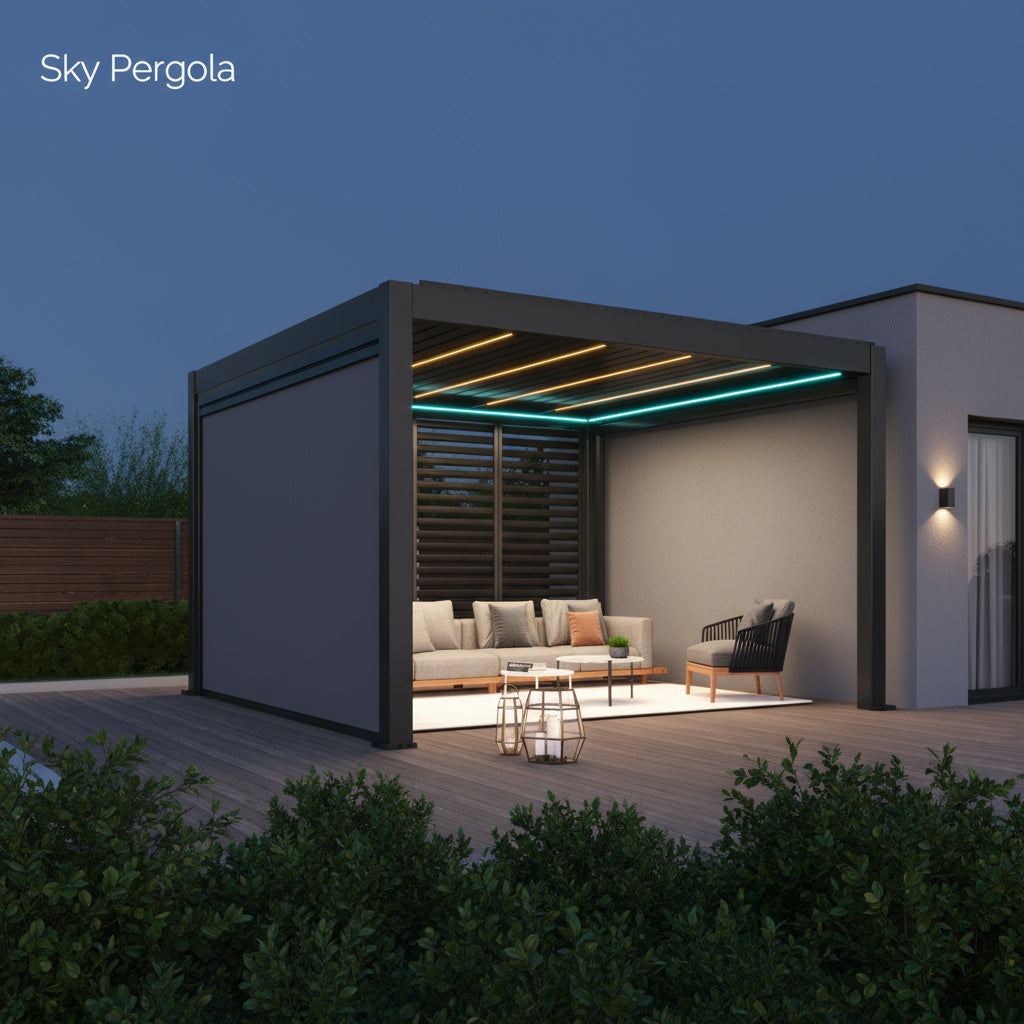
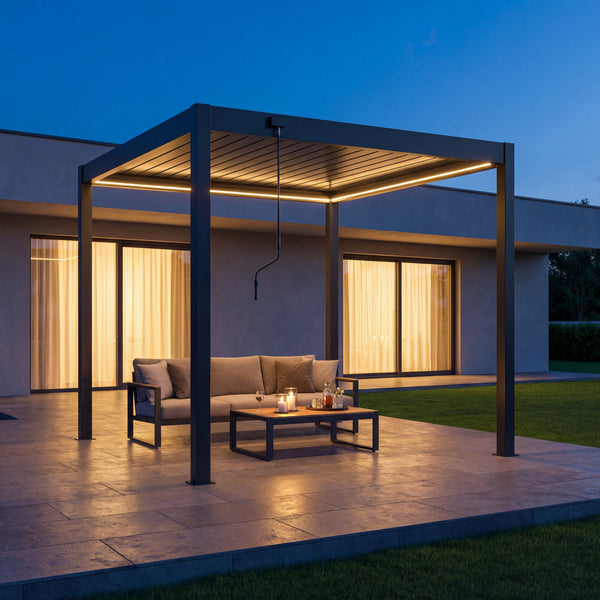
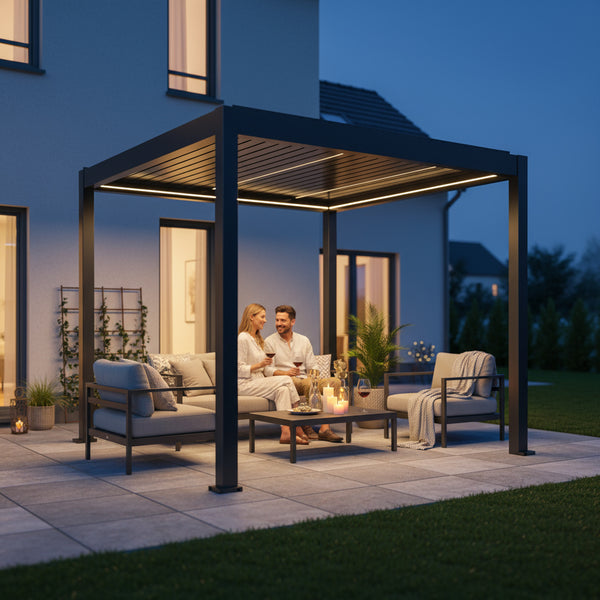
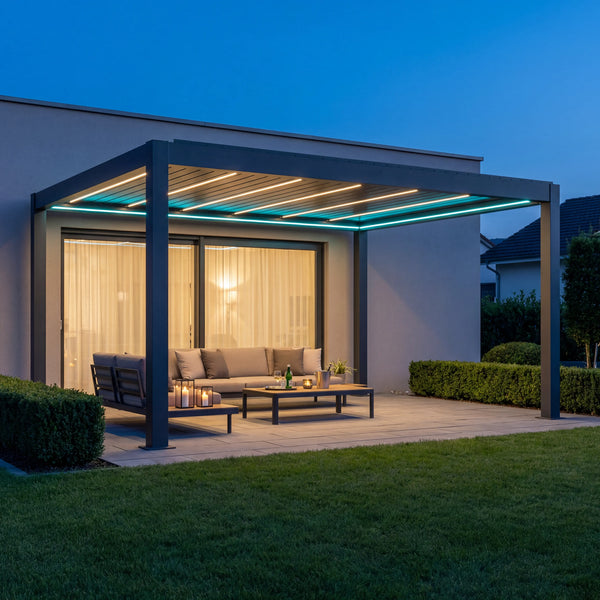

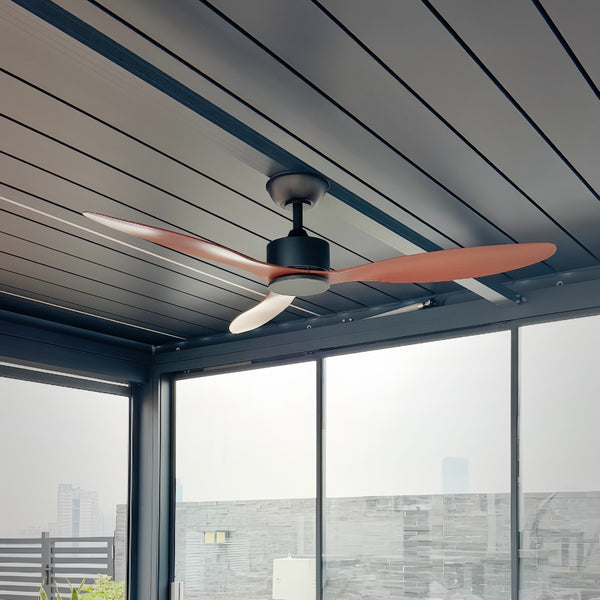




A pergola fan does the one thing a louvre roof cannot do on its own: it moves air across your skin. Shade takes the sun out of the equation, but it does not touch the still, heavy air that sits under a closed roof on a coastal evening in October. Air movement does, and that is usually the difference between a terrace that gets used after sunset and one that stays empty until December.
This guide covers the part most articles on pergola cooling in Dubai skip: how an outdoor ceiling fan is physically built into a rotating aluminium louvre roof. The fixed member it has to land on, the headroom it costs you, the clearance it needs to louvres, posts and screens, how to match blade span to the bay between your posts, and what Gulf dust and coastal salt do to the hardware over a few seasons. You will also see the fan compared with misting and with side shading, the two alternatives most people weigh against it.
Two things up front, because they shape every decision that follows. A fan cools people, not places: it raises the rate at which your body loses heat and leaves the measured air temperature almost untouched [1][2]. And there is a temperature above which moving air stops helping and begins to work against you [3] — a temperature Dubai spends a good part of the summer above [4].
Key takeaways
- A fan works on you, not on the terrace: elevated air speed increases convective and evaporative heat loss from the skin [1], and a design air speed of 0.5 m/s is taken as roughly a 2 °C cooling effect [5].
- It has an honest ceiling. The WHO advises fans only below 40 °C, because above that moving air heats the body [3], and notes that above 35 °C a fan may not prevent heat-related illness [6]. Dubai's August mean daily maximum is 41.9 °C [4].
- The fan never mounts on a moving louvre. It belongs on a fixed structural member that carries the load into the posts, with blade tips clear of the louvre travel path in every position.
- Size it by covered area, not by taste: 36 to 42 in (about 91 to 107 cm) suits 76 to 144 sq ft (about 7 to 13 m²), and above 400 sq ft (about 37 m²) you want 60 in or several fans [7], spaced 8 to 10 feet (about 2.4 to 3.0 m) apart [8].
- In the UAE, specify for dust first: PM10 averaged 126 µg/m³ across 50 national stations in 2022, over eight times the WHO annual guideline [9]. Per IEC 60529 the first IP digit separates dust-protected (5) from dust-tight (6) [10].
- Misting is the weaker option on the coast: mean vapour pressure nearly doubles from 14.6 hPa in January to 28.7 hPa in August [11], and mist systems carry a documented hygiene duty [12].
Short answer: what a pergola fan can and cannot do in Dubai
A pergola fan is a comfort device with a well-defined working range. Inside that range, air movement is what changes perceived comfort rather than any further layer of shade, because it accelerates heat loss from the skin [1]. Outside that range, no blade span and no motor rating will save you, and the honest answer is side shading, a cooled enclosed space, or a different hour of the day. You will also see the hardware listed as a pergola ventilator or simply as an outdoor ceiling fan — it is the same product category.
The mechanism: it works on your body, not on the air
Fans increase air speed, and air speed increases heat transfer away from the skin by convection and by sweat evaporation [1]. Nothing about the terrace itself gets cooler. This is why it pays to switch the fan on when people sit down and off when they leave [2].
The effect is quantifiable enough to design with. A design air speed of 0.5 m/s is treated as roughly a 2 °C cooling effect on perceived temperature [5], and the US Department of Energy puts the practical benefit of a ceiling fan at about 4 °F, roughly 2 °C, of thermostat setback with no reduction in comfort [2]. Where a space is enclosed and cooled, the figure is larger: air conditioning set to 27 °C plus a fan makes a room feel 4 °C cooler [13]. In comfort engineering this is a method rather than a rule of thumb: the ordinary comfort model in ANSI/ASHRAE Standard 55 is applicable only up to an air speed of 0.2 m/s, and above that the Elevated Air Speed Comfort Zone Method with the Standard Effective Temperature index is used to credit what the fan does [14].
The ceiling: 35 °C, 40 °C, and why humidity moves the line
WHO heat guidance carries two numbers worth knowing. Above 35 °C a fan may still provide relief but may not prevent heat-related illness [6]; fans should be used only below 40 °C, because in temperatures above 40 °C they heat the body [3]. Read 35 °C as the point where the fan stops being a safety measure and becomes a comfort measure, and 40 °C as the point where it stops being useful at all.
Neither number is a fixed line, because humidity moves it: the maximum operative temperature at which heat strain is anticipated lowers as relative humidity rises [15]. That is the Dubai-specific catch. Coastal air here is loaded with water vapour — mean vapour pressure at Dubai International rises from 14.6 hPa in January to 29.1 hPa in July and 28.7 hPa in August [11] — and the UAE National Center of Meteorology's heat index shows the consequence: at 65 to 75% relative humidity, an air temperature of 40 °C creates a sensation equivalent to 45 °C or higher, because sweat cannot evaporate efficiently [16]. Sweat evaporation is precisely the mechanism the fan depends on [1]. Regional research frames the physiological hard limit as a wet-bulb temperature of about 35 °C sustained for more than six unprotected hours, with Dubai among the Gulf cities projected to approach it [17]. Any outdoor cooling concept in the Emirates is therefore comfort within a season, not year-round usability.
What that means for your calendar
Mean daily maximum at Dubai International falls from 35.9 °C in October to 24.4 °C in January and is back at 33.7 °C by April [18]. August sits at 41.9 °C, and even the mean daily minimum stays at 31.5 °C [4], so the coolest hour of an August night is still a warm one. The fan earns its keep in two windows: the shoulder months, where it converts a 33 to 36 °C afternoon from unusable to usable, and summer mornings and nights, where air movement does most of the work on an open terrace.
| Air temperature under the roof | What the fan does | What you need in addition |
|---|---|---|
| Under 30 °C (roughly December to February) [18] | Often more draught than you want; run it low or leave it off | Shade control, and a patio heater on cool evenings |
| 30 to 35 °C (April, early mornings, October afternoons and evenings) | Its best range: a noticeable cooling effect at a moderate air speed [5] | Louvres angled to vent, one open side for cross-flow |
| 35 to 40 °C (May, late September, summer nights) | Still gives relief, but as comfort only, not as protection [6] | Vertical shading against low sun, shorter sessions, water |
| Over 40 °C (June to August midday) [4] | Works against you: moving air heats the body [3] | A closed, cooled space; the fan belongs off |
How a ceiling fan actually gets into a louvre roof
This is where a pergola with a fan differs from a porch with a fan, and where most planning goes wrong. A motorised bioclimatic louvre roof is not a ceiling. It is a field of aluminium blades that rotate in unison through roughly 0 to 135 degrees, driven by a quiet linear actuator and a linkage, and on our systems the motor sits hidden inside the carrier beam. Nothing in that moving field is a fixing point.
The fan lands on a fixed member, never on a louvre
The only acceptable mounting point is structural and static: a fixed member of the frame, not a blade in the moving field. A louvre carries its own weight and wind load, pivots several times a day and has to stay in alignment with every other blade in the field. Hanging a rotating mass from it is not a compromise, it is a failure in waiting. The same caution applies to the drainage profiles: the frame doubles as the gutter, water runs inside the beams and down the posts, so a bracket must never be drilled into a channel that carries water. Those two rules — never on a moving louvre, never into a water-carrying profile — hold for any fan under any louvre roof.
The load path is dynamic, not static
A ceiling fan weighs little, but it does not behave like a static load. It applies a rotating out-of-balance moment, it reacts to side wind on the blades, and it transmits vibration into whatever holds it. The fixing therefore has to be designed as part of the structure and taken down into the posts, not screwed into a convenient spot. The basic wind speed of 45 m/s reported for Dubai, a three-second gust equivalent to 160 km/h, comes from the discussion of wind codes for towers [19]; which edition and which value apply to your plot is something the structural engineer confirms, because the beam, the fixings and the frame share that load case.
Mounting point and cable route: a question for the configuration stage
Two things decide how tidy the result is: whether there is a fixed member where you want the fan, and where the supply cable can run. Both depend on the configuration, so clarify with us before you order whether a fixed mounting point and a cable route inside the frame are possible for your model and size. Retrofitting is the harder case: an existing frame may have no fixed member where you want the fan, the cable may have to run in a surface conduit, and the available fixing point can push the fan off the centre of the bay or force a smaller blade span. If a fan is even a possibility, raise it at the configuration stage rather than after installation. The Sky Pergola Fan starts from AED 6,705 and is operated by a remote control with multiple speeds.
Sizing and positioning: headroom, blade span, clearance
Free headroom comes first
Industry practice for outdoor ceiling fans is to keep at least 7 feet, about 2.13 m, between the floor and the blades [8]. Under a louvre roof that has to be carved out of a total height which is often capped by your community: reported pergola limits in Dubai run to a height of 2.5 to 3.0 m, with the figures varying by authority and community [20]. Subtract the 2.13 m and roughly 0.4 to 0.9 m is left for the louvre field, the carrier beam, the fan fixing, the canopy and the drop rod. That is the entire budget, and it is why fan plans fail late: the fan is not too big, the roof is already using the height.
Practical consequences: use the shortest drop the fan allows, mount it tight under its fixing rather than hanging it low for looks, and if the arithmetic still does not work, move the fan out of the roof plane. A pedestal or wall-mounted outdoor fan has no headroom problem at all, and on a low terrace it is the more honest answer. Those are third-party devices from the specialist trade. Which mounting the Sky Pergola Fan is designed for is best clarified with us for your configuration.
Blade span against covered area and bay width
Blade span should follow the area the fan has to serve rather than the look you like. The common industry chart reads as below [7], with the pergola bay sizes that correspond.
| Covered area | Blade span | Comparable pergola bay |
|---|---|---|
| Up to 75 sq ft (about 7 m²) | 29 to 36 in (about 74 to 91 cm) | A seating nook of roughly 2.5 x 2.5 m |
| 76 to 144 sq ft (about 7 to 13 m²) | 36 to 42 in (about 91 to 107 cm) | 3 x 3 m (about 97 sq ft), 3 x 4 m (about 129 sq ft) |
| 144 to 225 sq ft (about 13 to 21 m²) | 44 to 50 in (about 112 to 127 cm) | 4 x 4 m (about 172 sq ft), 4 x 5 m (about 215 sq ft) |
| 225 to 400 sq ft (about 21 to 37 m²) | 50 to 54 in (about 127 to 137 cm) | 4 x 6 m (about 258 sq ft), 5 x 5 m (about 269 sq ft) |
| Over 400 sq ft (about 37 m²) | 60 in (about 152 cm) or more, or several fans | Multi-bay runs, for example 4 x 8 m and larger |
Read the table as a starting point, not as permission. The chart is drawn for rectangular patios, while a pergola bay adds its own constraint: the distance from the blade tip to the posts and to any side element. In a 3 m bay a 107 cm blade span sits comfortably inside the clear width; in that same bay a 152 cm fan does not, whatever the area chart says about the total covered surface.
Clearances, and the one figure you must get from the fan maker
- Floor to blades: at least 7 feet, about 2.13 m [8]. Measure to the finished floor, including any decking or tile build-up you are still planning.
- Blade tip to wall or structure: at least 18 inches, about 460 mm, is the common industry minimum [8], and individual fan manufacturers ask for more. The binding figure is the installation instruction of the fan you actually buy, so obtain it before you fix the position.
- Blade tip to the louvre field: check it with the louvres mid-rotation, not only closed and not only fully open. A fan that clears a closed roof can still foul a blade edge travelling through its arc.
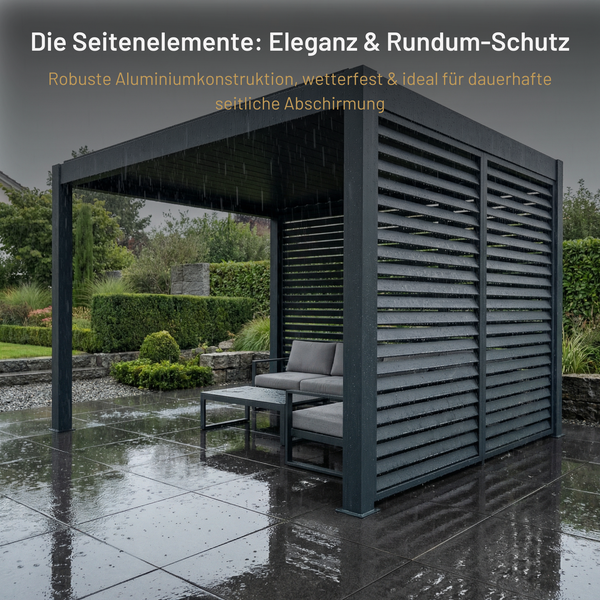
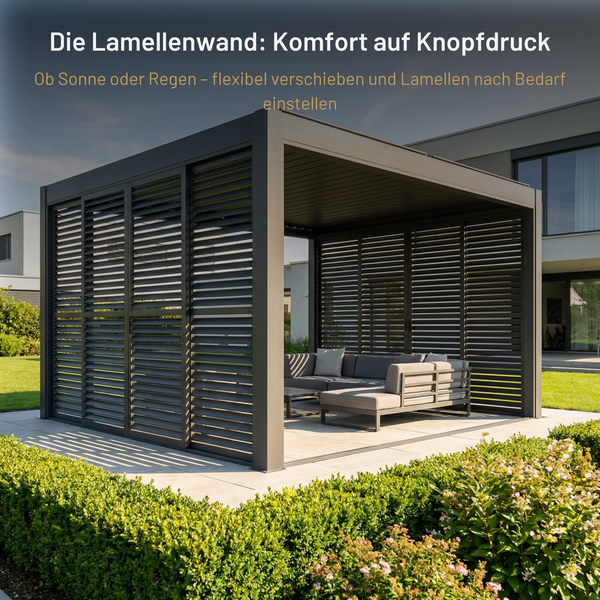
- Blade tip to side elements: measure against the element in its closed position, including a Sky Pergola Sliding Louver Wall on its track, because a sliding wall moves into the bay.
Long and multi-bay pergolas: two fans beat one
Above 400 sq ft the sizing chart itself stops recommending a single fan [7], and the spacing rule is 8 to 10 feet, about 2.4 to 3.0 m, between fans so their airflow fields do not overlap and cancel each other [8]. In practice, plan one fan per occupied zone rather than per square metre. In a 4 x 8 m run with a dining table at one end and a lounge at the other, one central fan gives both zones a weak draught and neither a useful one. Two correctly spaced fans, each sized for its own bay, use less diameter and deliver more air speed where people actually sit.
Where the fan goes, by use
- Dining: centre the fan over the table, not over the geometric centre of the bay. The air has to reach the shoulders and the back of the neck of seated guests; a fan centred on an empty part of the bay cools the floor.
- Lounge: offset towards the seating group. Reclined bodies present more surface to a downdraught, so a lower speed usually does the work.
- Outdoor kitchen: never above a grill, a hob or a heater. The rising heat and grease plume goes straight into the motor housing and the bearings, and the downwash disturbs the flame. Put the fan over the eating zone and keep the cooking zone outside the blade field.
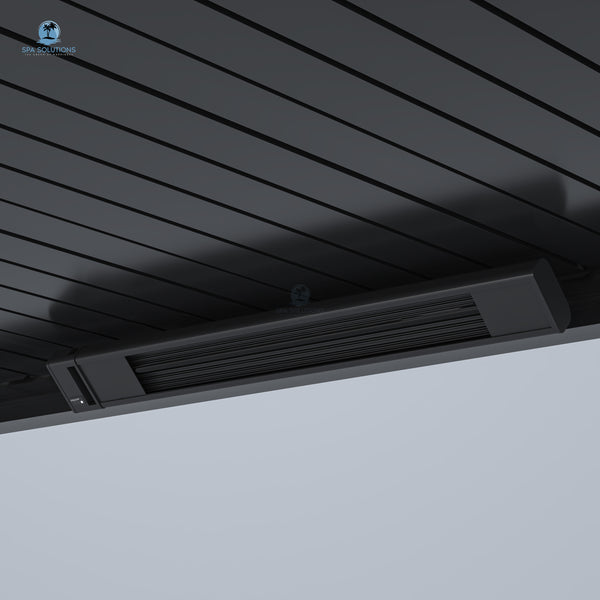
- Winter heating: the 150 cm Sky Pergola Patio Heater is a dark radiant heater, and air movement across a seated person dilutes exactly the warmth it is delivering. Place the two so their fields do not overlap, and run one at a time.
Built for Dubai: dust, moisture and salt air
Aluminium is the right frame material here, and for the same reasons the fan hardware has to be chosen with the Gulf in mind rather than picked from a generic patio range. Our aluminium pergolas for the UAE use marine-grade aluminium with a powder-coat finish. A fan is a different kind of assembly: a motor, bearings, electronics and fixings in several metals, and it is the weakest part of that assembly that sets the service life.
Damp-rated or wet-rated
A damp-rated fan is designed for covered outdoor areas where moisture is present but the fan is protected from direct exposure to water; a wet-rated fan is designed for fully exposed outdoor environments, and pergolas are named explicitly as wet-rated territory because they offer partial shade but still allow rain and moisture through [21]. A closed louvre roof sheds rain and drains it internally, but wind-driven rain reaches the edges of the bay, condensation forms on cool mornings, and the fan gets wet whenever the terrace is washed down. Specify wet-rated.
The IP digit that matters here is the first one
Per IEC 60529, the first digit of an IP mark distinguishes 5, dust-protected with limited ingress and no harmful effect, from 6, dust-tight with no dust ingress; the second digit runs 4 for splashing water from any direction, 5 for water jets from a 6.3 mm nozzle and 6 for powerful jets from a 12.5 mm nozzle [10]. In the UAE, dust is a permanent load rather than an occasional event: the 2022 average PM10 across 50 national ground monitoring stations was 126 µg/m³, more than eight times the WHO annual guideline of 15 µg/m³, and not one of the 50 stations recorded a compliant yearly average in any year from 2018 to 2022 [9]. That is why the first IP digit [10] is the number to argue about, and in practice a sealed motor with sealed bearings matters more for service life than blade count or styling. Ask for the IP mark of the specific model, not of the product range.
Salt air: within 5 km of the coast you are buying a different specification
Per ISO 9223, a humid coast with high airborne salt is classed C5, very high corrosivity, while CX, extreme, is reserved for offshore and sea-spray exposure [22]. A terrace in Jumeirah, on the Palm or along the Marina therefore sits in a harsher exposure class than an inland villa, and the mechanism is settled sea salt on the surface working its way into the metal rather than a defect in the coating itself [23]. In architectural powder coating the coastal answer is a deeper pre-treatment: QUALICOAT Seaside class doubles the minimum aluminium removal from 1 g/m² to 2 g/m², using a dip or spray process with an acid or a combined acid and alkaline etch, specifically to resist chloride attack [24], and the accepted trigger for specifying it is a site within 5 km of the coast or a tidal estuary [23].
Three practical consequences for a fan on a coastal plot. Ask which coating specification applies to your frame and to the fan. Insist on corrosion-resistant fixings rather than whatever came in the box, because fan and frame form a mixed-metal assembly in salt air. And rinse with fresh water on a routine, since what you are removing is chloride and dust, not dirt.
Shamal season: switch off, then rinse
The summer shamal is a season rather than bad luck. The persistent northwesterly dust wind usually begins on 30 May and subsides by 16 August, and wind speeds over 11 m/s are enough to lift sufficient dust to reduce visibility under 3.5 km, the typical dust-storm threshold [25]. During a dust event the worst thing a fan can do is run, because it draws dust-laden air through the motor and bearings. Close the louvre roof, switch the fan off, and afterwards rinse blades and housing with water rather than a jet, unless the second IP digit of your model actually allows a jet [10]. A tight fabric cover is usually the wrong answer: it traps grit against the finish and tends to be forgotten in place.
Working with the louvres: which angle ventilates and which traps heat
The bioclimatic principle is that one roof gives deep shade or open sky depending on the blade angle. For a fan this matters more than it looks, because the louvre position decides whether the heat the fan is stirring has any escape route.
Closed roof: shade without an exit
Fully closed, the overlapping blades give the deepest shade and the rainproof position, with the water channelled away inside the frame and down the posts. They also cap the space: warm air rising off the floor, the furniture and the people has nowhere to go and forms a hot layer under the roof. A fan in that situation still works, because it works on skin rather than on air [1], but it is recirculating. Use the closed position when you need shade or rain protection, and give the air a horizontal way out.
Partly open: the position that actually vents
Tilt the blades so that the gap between them opens away from the sun's bearing, with the upper edge of each blade pointing towards the sun. The blade still intercepts the direct beam, while the gap gives the hot layer a path upward instead of trapping it. This is the position to use at the start of an October evening, and the one that is easily overlooked, because the roof tends to get treated as binary: open or shut. On a manual louvre roof the logic is identical, it simply takes a handle instead of a motor.
Cross-flow decides the result
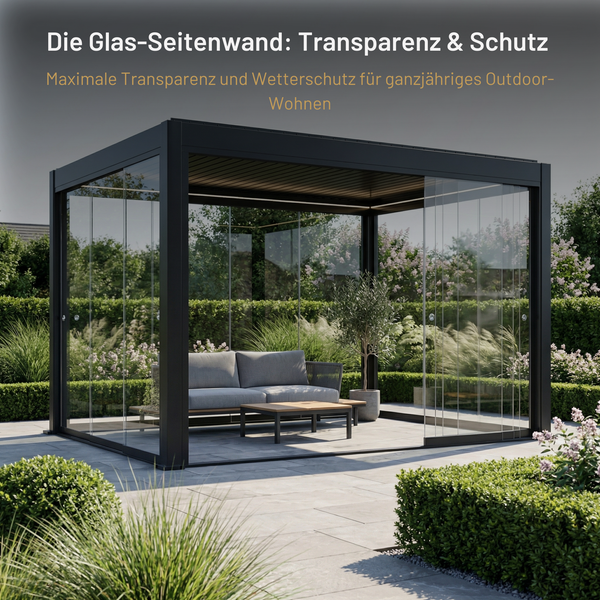
Air movement needs an inlet and an outlet. Three closed sides plus a closed roof turn the pergola into a box, and the fan then churns the same warm volume, which is why a fan can feel ineffective in a tightly enclosed corner. Keep one side open, or keep the blades of a louvre wall open while the panel itself stays in place for privacy. Once the space is fully enclosed in glass you are no longer in fan territory: an enclosed shell holds conditioned air, which is the point of a glass enclosure, and the fan becomes the companion to the cooling rather than a substitute for it [13].
A sequence that works in the shoulder season
- Before anyone sits down, open the roof fully and let the trapped hot layer leave the space.
- Tilt the louvres to shade the seating against the current sun bearing, with the gaps opening away from the sun.
- Start the fan at a low speed and raise it only until the draught is felt at shoulder height. Beyond that, more speed is not more comfort.
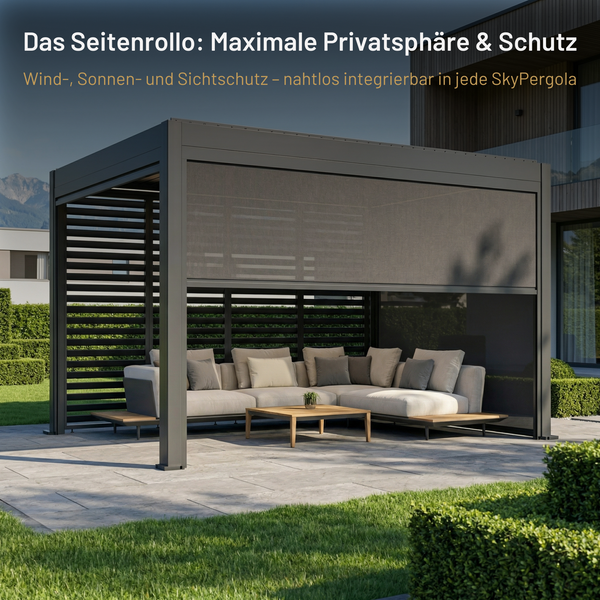
- Lower a side element only against low sun or blowing dust, and only on the affected side, so that cross-flow survives.
- Switch the fan off when the group leaves. It cools people, not places [2].
Fan, misting or side shading: what to use when
These three are less competitors than tools for different jobs, and the decision worth getting right is which hour of the day actually bothers you.
| Option | What it changes | Where it works in Dubai | The catch |
|---|---|---|---|
| Outdoor ceiling fan | Raises air speed, so the body sheds heat faster [1] | Roughly 30 to 35 °C, with relief up to 40 °C [6][3]: shoulder months, mornings, evenings | Works against you above the WHO ceiling [3]; needs a fixed member and headroom |
| Misting system | Evaporates water into the air, lowering air temperature | Dry inland air that still has room for evaporation | Little headroom at the coast in summer [11]; adds humidity; ongoing hygiene duty [12] |
| Side shading (side blind, louvre wall, side element) | Blocks low-angle direct sun and radiant load from outside | Late afternoon sun, blowing dust, privacy, all year | Reduces cross-flow, so it pairs with a fan rather than replacing it |
| Glass enclosure plus cooling | Separates the space from outdoor air entirely | Summer midday, when nothing passive is enough | A different investment class; the fan then supports the cooling [13] |
Why misting disappoints on a coastal plot
Evaporative cooling only delivers what the air has room to absorb, and at the coast in summer that room is small: the water vapour already in the air nearly doubles from winter to late summer [11]. Humid air also makes a given temperature feel hotter, precisely because sweat cannot evaporate efficiently [16]. Adding water vapour to that air pushes in the same direction, and the useful temperature ceiling for air movement drops as relative humidity rises [15]. Inland, and in the shoulder months, mist can do something real. On a humid August evening near the sea it mostly makes cushions damp.
There is a second difference that rarely reaches a brochure. Outdoor water mist systems release microscopic inhalable aerosols in the 0.3 to 10 µm range [26]. Testing of such systems found Pseudomonas aeruginosa in 44% of samples, Legionella pneumophila serogroups 2 to 14 in 18% and serogroup 1 in 6%, with the authors calling for prevention of water stagnation, implementation of effective maintenance programmes and adequate disinfection [12]. That is a permanent service obligation. A ceiling fan needs cleaning; a mist line needs a hygiene regime.
Side shading is the summer lever
If the problem is a 36 °C afternoon with the sun coming in flat from the west, air movement is the wrong tool and a vertical screen is the right one. A Sky Pergola Side Blind takes the direct beam and the blowing sand out of the seating area, and a fixed or sliding louvre wall does the same with more structure and more privacy. The sequence that earns its keep in the UAE is layered: shade from the roof, vertical shade against low sun, then air movement for the people underneath, and cooled air behind glass for the weeks when none of that is enough.
Living with it: October to April, and the summer months
The shoulder and winter routine
- October and April are the fan's months: mean daily maximum is 35.9 °C in October and 33.7 °C in April [18], so midday stays marginal while everything from late afternoon onwards becomes usable with air movement.
- In the cool middle of the season, January's mean daily maximum is 24.4 °C [18]. The fan mostly stays off and the heater does the work.
- Run the fan on occupancy, not as a default setting [2].
- Decide the operating speed by what you feel at shoulder height, not by the number of steps the remote offers.
Summer: early, late, or not at all
Between June and August the window is narrow. Even at night the air stays warm, with an August mean daily minimum of 31.5 °C [4], so what makes an early morning or a late evening usable is air movement across the skin [1] rather than any drop in measured temperature. Midday is out: a mean daily maximum of 41.9 °C [4] sits above the ceiling described earlier, where moving air heats the body [3]. The sensible summer pattern is the roof closed for shade, the fan used in the early morning and the late evening, side screens against dust through the shamal window from the end of May to mid-August [25], and anything in the middle of the day happening behind glass.
Cleaning, and what actually kills a pergola fan
- Dust on the blades is not cosmetic. An uneven film unbalances the blade set, and an unbalanced fan loads its bearings and begins to wobble. Wipe the blades whenever a film is visible rather than on a calendar.
- Bearings and the motor seal are the service-life items, so the first IP digit [10] tells you more about what the fan will survive than the number of speeds does.
- On a coastal plot, rinse with fresh water as a routine. You are removing settled salt, and settled salt is what drives corrosion [23].
- Check the mounting bolts at the start and the end of the season. A Gulf year of thermal cycling works on every bolted joint.
What it costs to run
A verified monthly running cost needs the current utility tariff and your own consumption band, so ask your electricity provider for the slab that applies to you rather than trusting a figure from a brochure. What can be said is the direction of the benefit: a ceiling fan allows a cooling setpoint to be raised by about 4 °F, roughly 2 °C, with no reduction in comfort [2], and with air conditioning at 27 °C a fan makes a room feel 4 °C cooler [13]. On an open terrace the running hours are the part you control.
Permits, structure and electrics in Dubai
Do not assume that adding a roof structure with a fan and lighting is a free decision anywhere in Dubai, and do not take a neighbour's build as evidence. According to a Dubai engineering consultancy, which authority approves it depends on the community: Dubai Municipality for Emaar communities such as Meadows, Springs and Lakes and for mainland plots, the Dubai Development Authority for Dubai Hills, Arabian Ranches and The Valley, and Trakhees for Nakheel communities including JVC, JVT and Palm Jumeirah, with villa communities additionally requiring a developer NOC [27]. Have the position for your own plot confirmed by the responsible authority before you order.
Dimensional limits are set per community rather than nationally. Reported caps are a height of 2.5 to 3.0 m, a footprint around 3 m by 4 m and a setback of 1.5 to 3.0 m from plot boundaries, with the exact figures varying by authority and community [20]. The height cap is the one that decides your fan, as the headroom arithmetic above shows, so have the applicable figures confirmed for your plot before you fix a roof height.
On the structural side, any member that carries a fan shares the wind load case of the frame (see above), so let the structural engineer confirm which code edition and which value apply to your plot. On the electrical side, keep it simple and lawful: the supply for a fan in a metal structure outdoors should be installed and signed off by a licensed electrician, and the fixing point and the cable route should be clarified with us before the frame is manufactured. If you are unsure what applies in your community, send us your plot details and the community name and we will go through it with you.
Which Sky Pergola setup a fan fits into, and a checklist before you order
No model needs a fan, and every model becomes more usable in the shoulder season with one. What changes between them is the bay geometry, the height budget and whether the roof plane moves in one piece.
Three cases, and what they mean for a fan
- Single bay, 3 x 3 m — for example SkyMotion LED (from AED 28,755), a motorised louvre roof with LED integrated in the frame. About 97 sq ft, which puts it in the 36 to 42 in band of the sizing table above [7]. One fan, centred on the seating rather than on the bay, is the whole plan.
- Multi-bay run, 4 x 6 m — for example SkyMax Ultra. About 258 sq ft, the 50 to 54 in band in the same table [7]. Over a long run, two fans spaced 8 to 10 feet apart [8], one over the table and one over the lounge, do more than one large one, and the clear width between posts usually decides the diameter before the area chart does.
- Enclosed — SkyPergola Conservatory. Enclosing the space moves the discussion from air movement to conditioned air. A fan there is the companion to cooling [13], not an alternative to it.
One detail worth planning around: LED lighting on these models is integrated inside the frame and directed downwards, so a fan with its own lamp is usually redundant. In practice, a fan hanging below downward lighting also tends to throw a rotating shadow across the table, so decide light and fan positions together rather than one after the other.
Checklist before you order the fan
- Fix the use of each bay first: dining, lounge or cooking. The fan follows the people, not the geometry.
- Establish the finished floor-to-roof height and subtract 2.13 m of free headroom under the blades [8].
- Confirm the height, footprint and setback limits that apply in your community [20].
- Decide the fan position early, and clarify with us whether a fixed mounting point and a cable route inside the frame are possible in your configuration.
- Size the blade span from the covered area [7], then check it against the clear width between posts.
- Get the fan manufacturer's required clearances in writing: plan on at least 18 inches laterally [8].
- Check blade-tip clearance to the louvres through the whole rotation, and to side elements in their closed position.
- Specify wet-rated [21], and ask for the IP mark of the exact model, with attention to the first digit [10].
- Within 5 km of the coast, ask which coating and fixing specification is applied [24][23].
- For areas over about 37 m², plan two or more fans at 8 to 10 feet spacing instead of one large one [7][8].
- Agree who carries out the electrical work and the sign-off before installation day.
The honest recommendation
If your terrace is used from October to April, a pergola fan is a modest addition with a disproportionate effect, and the reason is physiological rather than mechanical: it raises the rate at which your body sheds heat [1], worth roughly 2 °C of perceived temperature at a design air speed of 0.5 m/s [5]. Buy it for that, buy it wet-rated and dust-sealed, size the blade span to the bay, and mount it on a fixed structural member. It will quietly extend your season at both ends.
Do not buy it as a summer solution. Past the WHO thresholds set out above it is comfort rather than protection, and higher still it works against you [6][3], which in Dubai describes a normal August afternoon [4]. For those weeks the honest answer is shade, vertical screening and a cooled enclosed space. If you are weighing a fan against misting on a coastal plot, the humidity data settles it: air movement and shade, not more water in the air [11].
The practical next step is to decide the bay layout and the fan position together, because both belong in the planning before the frame is made. Put your sizes and zones into the Sky Pergola configurator, note where you want the fan, and ask us to check the headroom and the clearances against the model you have in mind.
Frequently asked questions
Can you actually put a ceiling fan under a louvred bioclimatic roof?
Yes, if it is planned rather than improvised. The fan must land on a fixed structural member, never on a rotating louvre and never on a profile that carries drainage water. The blade tips have to clear the louvres through the whole rotation. Whether a fixed mounting point and a cable route inside the frame are possible in your configuration is best clarified with us before you order, because both belong in the planning rather than in a later retrofit.
Will a fan really help at 40 °C and high humidity, or does it just move hot air?
At 40 °C, barely. The WHO advises using fans only below 40 °C, because above that moving air heats the body[3], and above 35 °C a fan may not prevent heat-related illness[6]. Humidity lowers that ceiling further[15], and at 65 to 75% relative humidity, 40 °C already feels like 45 °C or higher[16]. Use the fan in the shoulder months, mornings and evenings.
What blade diameter do I need for my pergola?
Work from the covered area. Up to 75 sq ft calls for 29 to 36 in, 76 to 144 sq ft for 36 to 42 in, 144 to 225 sq ft for 44 to 50 in, 225 to 400 sq ft for 50 to 54 in, and above 400 sq ft either 60 in or several fans[7]. Then check the result against the clear width between your posts and the 18 inch lateral clearance[8].
How much headroom do I need under a louvre roof for a ceiling fan?
Keep at least 7 feet, about 2.13 m, between floor and blades[8]. Reported community height caps in Dubai are 2.5 to 3.0 m[20], which leaves roughly 0.4 to 0.9 m for the louvre field, the carrier beam, the fan fixing and the drop. Use the shortest drop the fan allows, and if it still does not fit, a post- or wall-mounted fan from the specialist trade is the better answer.
Does a pergola fan need to be damp-rated or wet-rated, and which IP rating suits Dubai dust?
Specify wet-rated. Pergolas still admit rain and moisture, which is wet-rated territory, while damp-rated units are only for positions protected from direct water[21]. For dust, read the first IP digit: 5 is dust-protected, 6 is dust-tight[10]. UAE PM10 averaged 126 µg/m³ in 2022, over eight times the WHO annual guideline[9], so ask for the mark of the exact model.
Fan or misting system for a villa terrace on the coast?
On the coast, the fan. Evaporative cooling needs dry air, and mean vapour pressure in Dubai rises from 14.6 hPa in January to 28.7 hPa in August[11], so there is little headroom in summer. Mist systems also release inhalable aerosols of 0.3 to 10 µm[26] and carry an ongoing duty to prevent stagnation, maintain and disinfect[12]. A fan needs cleaning, not a hygiene regime.
Does the fan still do anything when the louvre roof is fully closed?
Yes, but less than you expect. A fan works on your skin, through convection and sweat evaporation, not on the air temperature[1]. Closed, the roof traps a warm layer underneath with no path upward, so the fan recirculates it. Keep one side open for cross-flow, or tilt the louvres so the gaps open away from the sun while the blades still shade the seating area.
Do I need a permit for a pergola with a fan and lighting?
Do not assume it is exempt. According to a Dubai engineering consultancy, which authority applies depends on your community: Dubai Municipality for Emaar communities and mainland plots, the Dubai Development Authority for Dubai Hills, Arabian Ranches and The Valley, and Trakhees for Nakheel communities including JVC, JVT and Palm Jumeirah, with a developer NOC additionally required in villa communities[27]. Dimensional limits are set per community[20], so have the figures for your plot confirmed by the responsible authority before you fix a roof height, and send us your plot details and the community name if you want us to go through it with you.
Sources
- Elevated air speed and thermal comfort (Fans Guidebook) – Center for the Built Environment, University of California, Berkeley
- Top 11 Things You Didn't Know About Saving Energy at Home: Summer Edition – U.S. Department of Energy
- Heatwaves: How to stay cool – World Health Organization
- WMO Climatological Normals 1991–2020, Dubai International Airport (41194) – World Meteorological Organization / NOAA National Centers for Environmental Information (data supplied by the UAE National Center of Meteorology)
- Elevated air speed and thermal comfort (Fans Guidebook) – Center for the Built Environment, University of California, Berkeley
- Heatwaves: How to stay cool – World Health Organization
- Ceiling Fan Size Guide for Outdoor Patios, Porches & Decks – City Lights San Francisco
- Ceiling Fan Size Guide for Outdoor Patios, Porches & Decks – City Lights San Francisco
- "You Can Smell Petrol in the Air": UAE Fossil Fuels Feed Toxic Pollution – Human Rights Watch
- IEC 60529 Explained – The IP Code – Standard Clarity
- WMO Climatological Normals 1991–2020, Dubai International Airport (41194) – World Meteorological Organization / NOAA National Centers for Environmental Information
- Opportunistic Premise Plumbing Pathogens: A Potential Health Risk in Water Mist Systems Used as a Cooling Intervention – Pathogens (MDPI), Masaka, Reed, Davidson & Oosthuizen, 2021
- Heatwaves: How to stay cool – World Health Organization
- Codes and standards (Fans Guidebook) – Center for the Built Environment, University of California, Berkeley
- Fans and heatwaves (CBE Thermal Comfort Tool documentation) – Center for the Built Environment, University of California, Berkeley
- '40°C but feels like 45°C': Why does it feel hotter than the actual temperature in UAE? – Gulf News
- Study: Persian Gulf could experience deadly heat – Massachusetts Institute of Technology (MIT News)
- WMO Climatological Normals 1991–2020, Dubai International Airport (41194) – World Meteorological Organization / NOAA National Centers for Environmental Information
- New wind codes for Dubai towers – Gulf News
- Dubai Pergola Guide: Types Allowed in Villas by Nakheel & DM – Structural Solutions (Dubai engineering consultancy)
- Wet Rated vs Damp Rated Fans: What Rating Your Outdoor Space Needs – Hunter Fan Company
- ISO 9223 Corrosivity Categories C1–CX Explained – Pelagard
- Powder coating in coastal environments – a different approach? – C&O Powder Coatings (Cando Coatings)
- What is QUALICOAT Seaside? – QUALICOAT UK & Ireland
- Sandy Shamal Season – NASA Earth Observatory
- Opportunistic Premise Plumbing Pathogens: A Potential Health Risk in Water Mist Systems Used as a Cooling Intervention – Pathogens (MDPI), Masaka, Reed, Davidson & Oosthuizen, 2021
- Shade Structure Approval Dubai – Structural Solutions (Dubai engineering consultancy)
Last updated: October 2026


